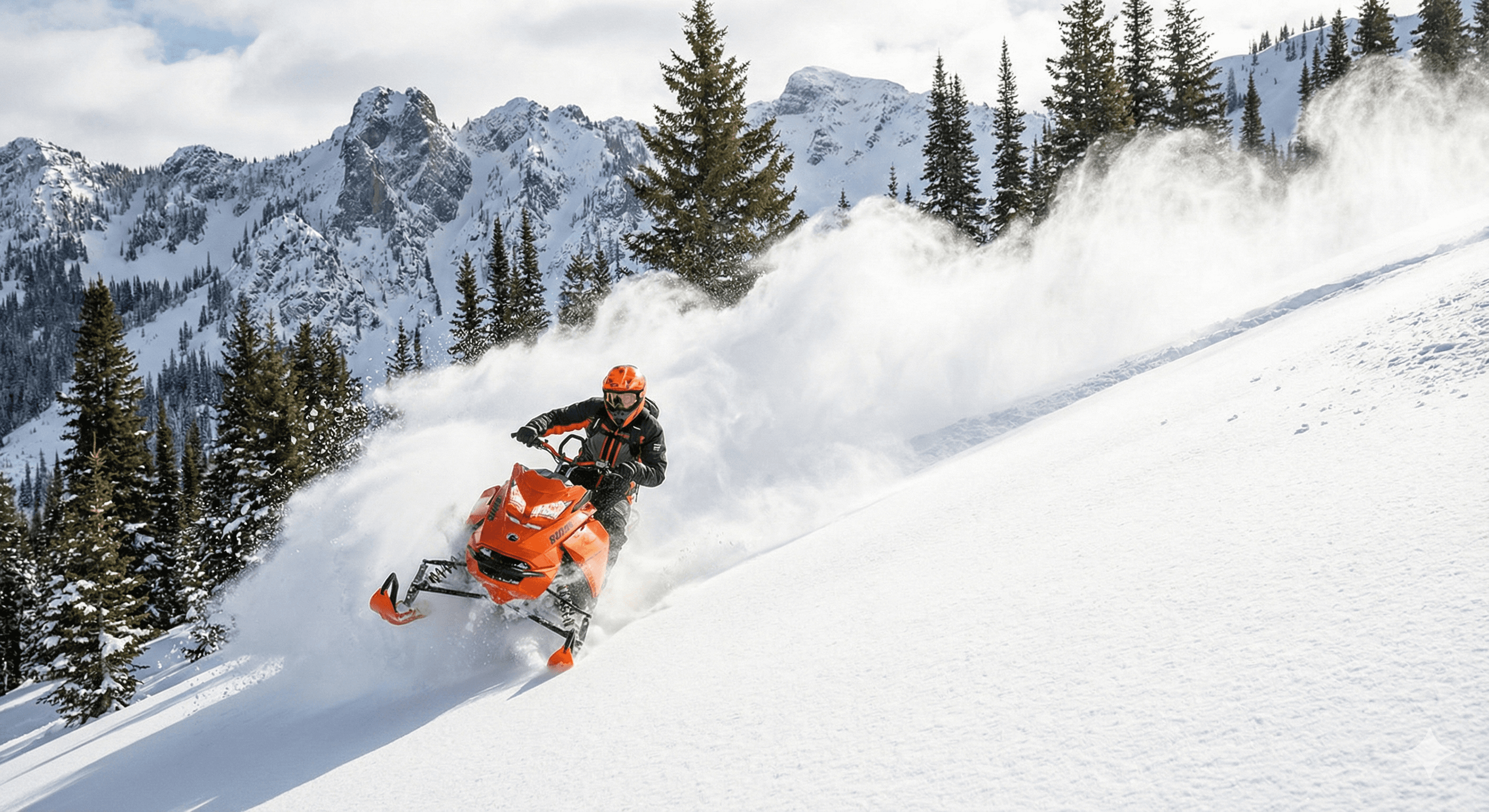
Whether you ride a high-performance trail sled or a touring snowmobile, this guide covers 2-stroke and 4-stroke snowmobile maintenance from pre-season prep through summer storage. We include engine oil service, chaincase lubrication, coolant system care, track tension and alignment, hyfax inspection, drive belt and clutch service, brake maintenance, and complete winterization and summer storage procedures. Select your riding conditions below for a schedule matched to your sled and your season.
A 4-stroke sled needs an oil and filter change every 100 hours or annually, with the first change at 25 hours. Check track tension, drive belt, and brake fluid every 50 hours. Change chaincase oil end of season, and coolant and brake fluid every 2 years. Drive belts last 1,500 to 3,000 miles. The biggest wins come at pre-season setup and summer storage. Your owner's manual sets the exact numbers for your model.
Jump to section
Intervals Calibrated for Real-World Riding
These intervals are based on data from major snowmobile manufacturers, adjusted for how people actually ride, not worst-case manufacturer specs. Use the rider profile selector above the schedule to match your riding style. Always cross-reference with your owner's manual for model-specific requirements, as your manufacturer knows your machine best. For intervals tailored to your exact machine, download LookOver free on iOS and Android.
What's the full snowmobile service schedule?
Service intervals for 2-stroke and 4-stroke snowmobiles. Adjust based on riding conditions and manufacturer recommendations.
Service Task
Interval
Engine
Engine Idle Speed
Inspect
Every 2,000 miles or 6 months
Spark Plug Inspect
Inspect
Every 4,000 miles or 12 months
Throttle Operation / Freeplay
Inspect
Every 2,000 miles or 6 months
Spark Plug Replace
Replace
Every 6,000 miles or 36 months
Transmission & Clutch
Drive Belt Inspect
Inspect
Every 1,000 miles or 3 months
Idler Wheel Bearings
Inspect
Every 1,000 miles or 3 months
Slide Rail / Hyfax Inspect
Inspect
Every 500 miles or 1 month
Track Condition Inspect
Inspect
Every 500 miles or 1 month
Track Tension / Alignment
Inspect
Every 300 miles or 1 month
CVT Clutch Service (Primary & Secondary)
Clean
Every 1,000 miles or 3 months
Drive Belt Replace
Replace
Every 3,000 miles or 24 months
Air & Intake
Air Filter Inspect
Inspect
Every 500 miles or 1 month
Air Filter Clean
Clean
Every 2,000 miles or 3 months
Air Filter Replace
Replace
Every 8,000 miles or 12 months
Fuel System
Carburetor Inspect / Clean
Inspect
Every 4,000 miles or 12 months
Choke Operation
Inspect
Every 2,000 miles or 6 months
Fuel Line Inspect
Inspect
Every 2,000 miles or 6 months
Fuel Strainer / Petcock Screen
Clean
Every 8,000 miles or 24 months
Exhaust
Exhaust System Inspect
Inspect
Every 4,000 miles or 12 months
Cooling System
Coolant Hoses Inspect
Inspect
Every 4,000 miles or 12 months
Coolant Level Check
Inspect
Every 500 miles or 1 month
Radiator Inspect / Clean
Inspect
Every 2,000 miles or 6 months
Coolant Replace
Replace
Every 12,000 miles or 60 months
Electrical
Battery Inspect / Maintain
Inspect
Every 2,000 miles or 3 months
Wiring / Electrical Inspect
Inspect
Every 4,000 miles or 12 months
Battery Replace
Replace
Every 36 months
Brakes
Brake Fluid Inspect
Inspect
Every 2,000 miles or 6 months
Brake Line Inspect
Inspect
Every 4,000 miles or 12 months
Brake Pad Inspect
Inspect
Every 2,000 miles or 6 months
Brake Rotor Inspect
Inspect
Every 8,000 miles or 24 months
Brake Fluid Replace
Replace
Every 24 months
Chassis & Hardware
Nuts, Bolts, Fasteners
Inspect
Every 2,000 miles or 6 months
Help Us Get These Intervals Right
These schedules are built from manufacturer data and real-world riding - but nobody knows your machine better than you. If something looks off, tell us. We read every message.
Set reminders based on hours, miles, or calendar time. LookOver tracks it all, even without internet.
New Sled Break-In
Proper break-in ensures long engine life. Follow these guidelines for the first 25 hours or 300 miles.
0-5 Hours
Vary throttle, avoid sustained high RPM
•Keep speed moderate
•No wide-open throttle
•Let engine warm up fully before riding hard
5-15 Hours
Gradually increase throttle usage
•Short bursts of higher RPM OK
•Continue varying speed
•Check all fluid levels
15-25 Hours
Near-normal riding, still vary RPM
•Avoid sustained max speed
•First oil change due at 25 hours (4-stroke)
•Inspect belt and track tension
When should I change my snowmobile's oil?
Proper lubrication is critical in cold conditions. Different requirements for 2-stroke and 4-stroke engines.
Four-stroke snowmobiles require regular oil changes like any 4-stroke engine, but cold weather operation demands specific attention.
Oil change interval: Every 100 hours or annually, whichever comes first. Change at 25 hours for break-in.
Oil type: Use manufacturer-specified synthetic oil rated for cold weather. Most require 0W-40 or 5W-40 full synthetic.
Cold weather consideration: Synthetic oil flows better at startup in freezing temperatures. Never use conventional oil in a snowmobile.
Checking level: Check with engine warm and sled on level ground. Top up only with the same oil type.
Two-stroke sleds use oil injection systems that mix oil with fuel automatically. Keeping the reservoir full is critical.
Check frequency: Before every ride. Running out of injection oil will destroy the engine within minutes.
Oil type: Use only high-quality 2-stroke injection oil rated TC-W3 or manufacturer-specific oil.
Injection system: The oil pump meters oil based on throttle position. More throttle = more oil. Never adjust the pump unless you know exactly what you're doing.
Premix backup: Some riders carry premix fuel (40:1 or 50:1) as emergency backup in case the injection system fails.
The chaincase connects the engine to the track via a chain and sprockets. It needs its own dedicated lubrication.
Check frequency: Pre-season and every 50 hours during the season.
Change interval: End of season or annually.
Oil type: Use manufacturer-specified chaincase oil. It's different from engine oil.
Signs of problems: Metal particles in oil, chain noise, or oil leaks around chaincase indicate worn components.
Track and Suspension
The track and suspension take a beating. Regular inspection prevents expensive repairs and keeps you riding.
Track Tension
Check tension before every ride in the first few hours, then weekly. Proper tension prevents track damage and improves handling.
Lift rear of sled
Measure deflection at center
Adjust per manual specs
Track Condition
Inspect for missing lugs, tears, or exposed cords. Damaged tracks can fail suddenly and cause accidents.
Check all lugs and clips
Look for cuts or tears
Inspect for wear patterns
Slide Rails (Hyfax)
Hyfax wear down with use. Running on worn hyfax damages the track and tunnel. Replace when worn to indicators.
Check wear indicators
Replace in pairs
Lubricate with snow only
Suspension Adjustment
Adjust suspension for rider weight and riding style. Factory settings are a starting point, not the final answer.
Set sag for rider weight
Adjust rebound/compression
Check for oil leaks
Cooling System
Most modern snowmobiles are liquid-cooled. The cooling system needs attention even in freezing conditions.
Snowmobile cooling systems rely on snow contact with heat exchangers. No snow = overheating risk.
Check level: Before every ride when cold. Low coolant leads to overheating even in winter.
Coolant type: Use manufacturer-specified coolant or 50/50 premix rated for powersports. Never use straight water.
Heat exchangers: Located in the tunnel and running boards. Keep them clear of ice buildup.
Snowmobiles can overheat even in winter. Understanding why helps prevent engine damage.
Common causes:
Riding on ice or hard-packed trails (no snow for cooling)
Low coolant level
Blocked heat exchangers
Failed thermostat
Air in cooling system
Prevention: Watch temperature gauge. If temp climbs, stop and pack snow around heat exchangers. On ice, take breaks to let the engine cool.
How do I store my snowmobile for the summer?
Proper storage prevents off-season damage and ensures your sled starts reliably next winter.
Fuel System
Fuel degrades over summer. Either drain completely or stabilize to prevent carburetor/injector damage.
Add fuel stabilizer
Run engine to circulate
Or drain tank completely
Fluids
Change oil and inspect all fluids before storage. Don't store dirty oil. It contains acids that damage bearings.
Change engine oil (4-stroke)
Top up injection oil (2-stroke)
Check coolant condition
Battery
Remove the battery and store indoors on a maintainer. A dead battery won't recover after sitting all summer.
Remove from sled
Clean terminals
Store on trickle charger
Protection
Protect your investment from dust, moisture, and critters. A cover and proper storage location make a difference.
Fog engine cylinders
Cover with breathable cover
Elevate track off ground
Log Your Storage Prep
Document what you did before storage. Know exactly where you left off next season.
Brake System
Reliable brakes are essential for safety. Snowmobile brakes work hard in varying snow conditions.
Brake fluid absorbs moisture over time, lowering its boiling point and causing corrosion.
Check level: Pre-season and every 50 hours. Top up if low, but investigate why it dropped.
Fluid type: DOT 4 for most sleds. Check your manual. Never mix types.
Change interval: Every 2 years regardless of use.
Inspect pads for thickness and disc for scoring. Worn brakes compromise stopping power.
Pad thickness: Replace when material is less than 2mm or at wear indicator.
Disc condition: Light scoring is normal. Deep grooves or cracks require replacement.
Caliper function: Pistons should retract smoothly. Sticky calipers cause drag and overheating.
When do I replace the drive belt on my sled?
The CVT system transfers power to the track. Belt condition directly affects performance and reliability.
The drive belt is a wear item that needs regular inspection and eventual replacement.
Inspection frequency: Every 50 hours or anytime performance feels off.
What to look for:
Width within spec (measure with calipers)
No cracks, fraying, or glazing
No missing cogs or chunks
Consistent wear across width
Replacement interval: Most belts last 1,500-3,000 miles depending on riding style. Aggressive riding wears belts faster.
The primary and secondary clutches need periodic cleaning and inspection.
Cleaning: Remove belt dust buildup from clutch faces annually or when performance degrades.
What degrades clutches:
Belt dust accumulation
Worn bushings or bearings
Glazed sheave faces
Weak or broken springs
Professional service: Full clutch rebuild is typically done by a dealer or clutch specialist every few seasons.
Skis and Front Suspension
Proper ski setup and suspension tuning improve handling and reduce fatigue.
Ski alignment affects handling, steering effort, and wear patterns.
Toe-out setting: Most sleds run 1/4" to 1/2" toe-out (front of skis slightly wider than rear).
Check method: Measure distance between ski tips and tails. Adjust tie rods to set alignment.
Symptoms of misalignment: Heavy steering, darting, or uneven ski wear.
Carbides provide grip on hard-packed snow and ice. Wear bars protect the ski runners.
Inspection: Check carbide height and condition. Worn carbides reduce control on ice.
Replacement: When carbides are worn to the runner or no longer provide grip.
Types: Longer carbides for aggressive trail riding, shorter for powder and off-trail.
Snowmobiles need regular engine oil changes (every 500-1,500 miles depending on engine type), chaincase oil changes, spark plug inspection and replacement, drive belt inspection, coolant checks, ski alignment verification, track tension adjustment, and carbide runner inspection. Two-stroke engines also require monitoring injection oil levels. Pre-season and end-of-season maintenance are especially important.
Check snowmobile spark plugs at the start of every season and inspect them every 500-1,000 miles during the riding season. Replace them if electrodes are worn, fouled, or if the gap is out of spec. Many riders replace plugs once per season as preventive maintenance. Always carry spares on longer rides.
At the beginning of every season, snowmobiles should receive a full tune-up including: fresh spark plugs, engine oil and chaincase oil change, coolant level and condition check, drive belt inspection (replace if cracked or worn), track tension and alignment adjustment, ski alignment check, brake inspection, throttle and brake cable lubrication, and a full controls and lights test.