
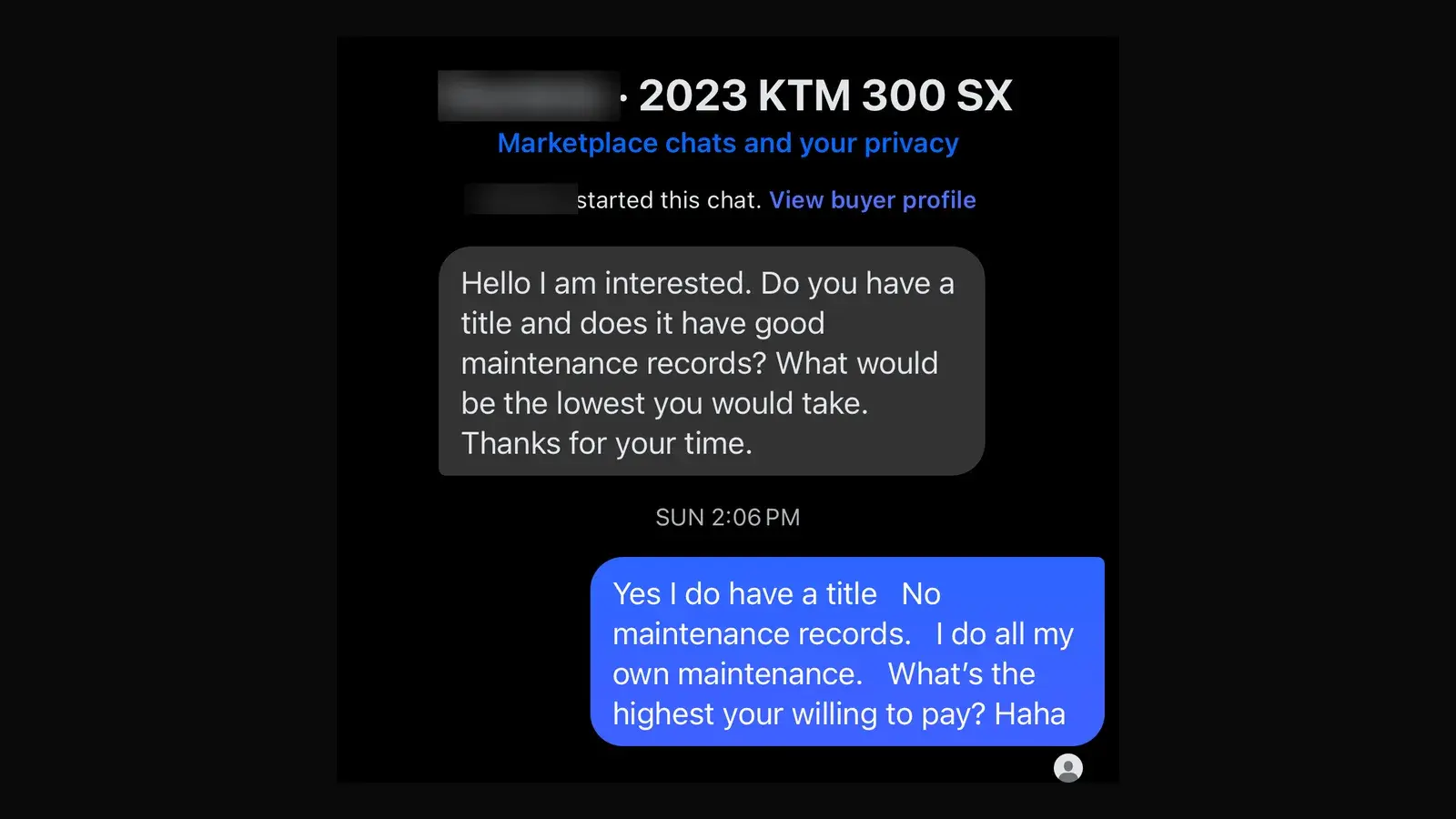
A buddy of mine listed his 2023 KTM 300 SX on Facebook Marketplace last week. Here is the first message that came in, word for word.
"Hello I am interested. Do you have a title and does it have good maintenance records? What would be the lowest you would take. Thanks for your time."
Three questions in one message. Title. Records. Price. That is the order nearly every serious buyer works in, and it is not an accident. The title tells them the bike is legal to sell. The records tell them whether it was cared for. Price comes last because the first two decide what they are willing to pay.
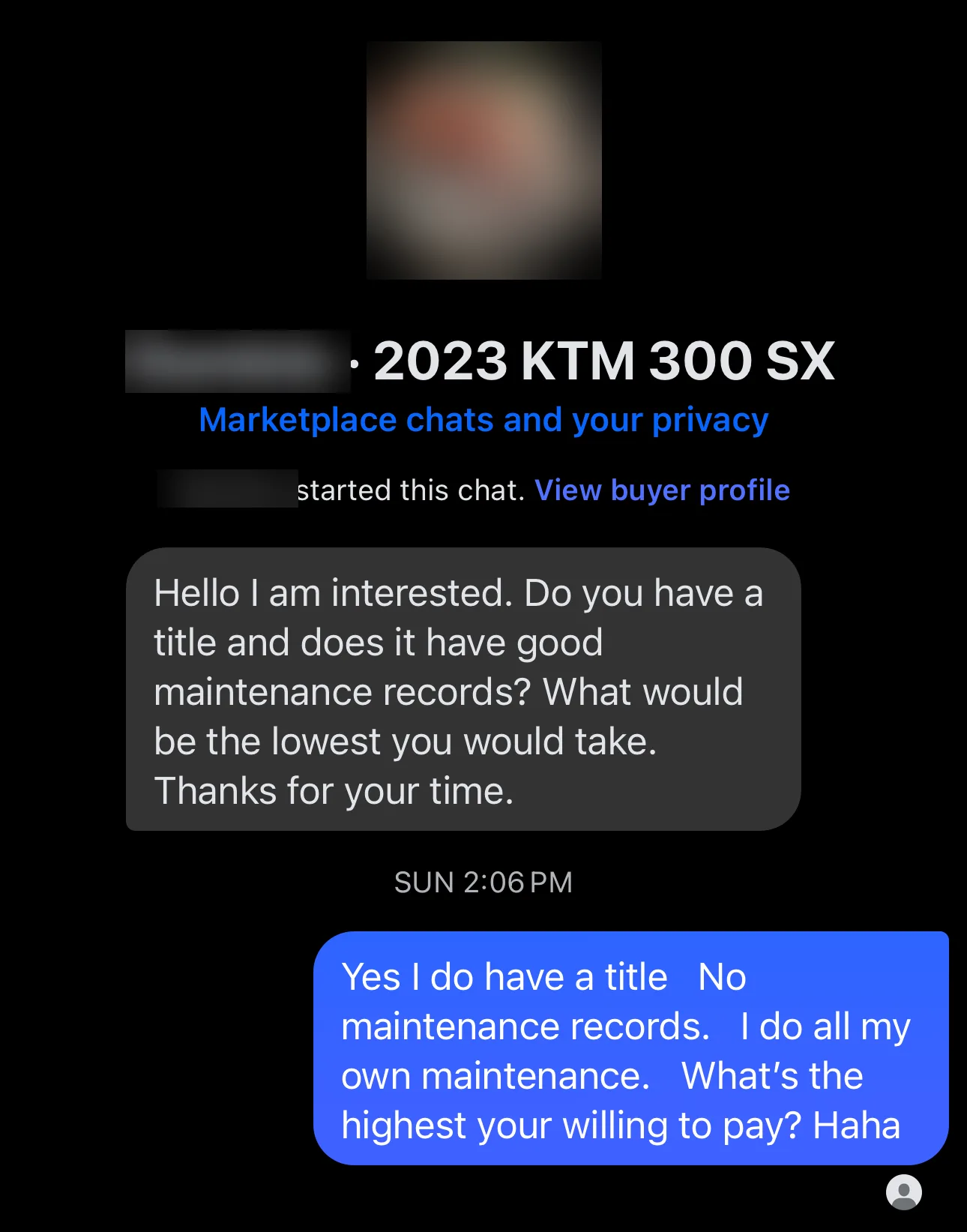
Names blurred to protect the innocent. The answer is the part that stings.
My buddy answered honestly. Yes on the title. No maintenance records. "I do all my own maintenance." Then he sent me the screenshot with one line: "Exact reason to use the tracker."
He is right, and I have been in that exact chat myself. So this is the practical version of that lesson. What a buyer actually means when they ask for records, what to have ready, and how to answer yes even if you are starting from nothing today.
What a buyer means by "good maintenance records"
A buyer on Marketplace cannot tell a well cared for bike from a neglected one by looking at it. Fresh plastics and a pressure wash hide a lot. So they ask for records, because records are the only thing that separates "I take care of it" from "trust me."
When they say good records, they are looking for something specific:
- Dates and hours. When each service happened, and how many hours or miles were on the machine at the time. On a race bike, hours since the last top end is the number they care about most.
- What was done. Oil changes, air filters, top ends, fork and shock service, valve checks, wheel bearings, chain and sprockets. The routine stuff counts. It shows a pattern, and the pattern is what they are buying.
- What went in. Oil weight, piston and ring brand, gasket kit, part numbers when you have them. Specifics read as true. Vague reads as made up.
- Proof. A receipt. A photo of the old piston next to the new one. Anything that ties the entry to a real day in a real garage.
Notice what is not on that list. Nobody cares if it is a spreadsheet, a notebook, or an app. They care that it exists, that it is specific, and that it lines up with the bike in front of them.
"I do all my own maintenance" is a strength. Show it.
DIY riders sometimes hear "no records" as a knock on their wrenching. It is not. Doing your own work usually means the bike got more attention than any shop would give it. The problem is that none of it got written down, so to a stranger it sounds exactly like the guy who did nothing.
The fix takes about 30 seconds after each job. Piston, ring, gasket kit, hours on the meter, done. In LookOver you can just say it out loud, "top end on the 300 at 42 hours, Wiseco piston, new base gasket," and Quick Log turns that into a dated service entry. That entry is worth more at sale time than the part itself.
The same habit works for an ATV, a side-by-side, or a sled. Anything that gets sold used gets asked the same question.
How to answer yes in under a minute
Here is how that same Marketplace conversation goes when the records exist.
The buyer asks. You open the app, pick the machine, tap Export Service Records, and a PDF drops into the chat. Every service, dated, with hours, parts, and the VIN at the top. They are scrolling through it before you have finished typing your reply.
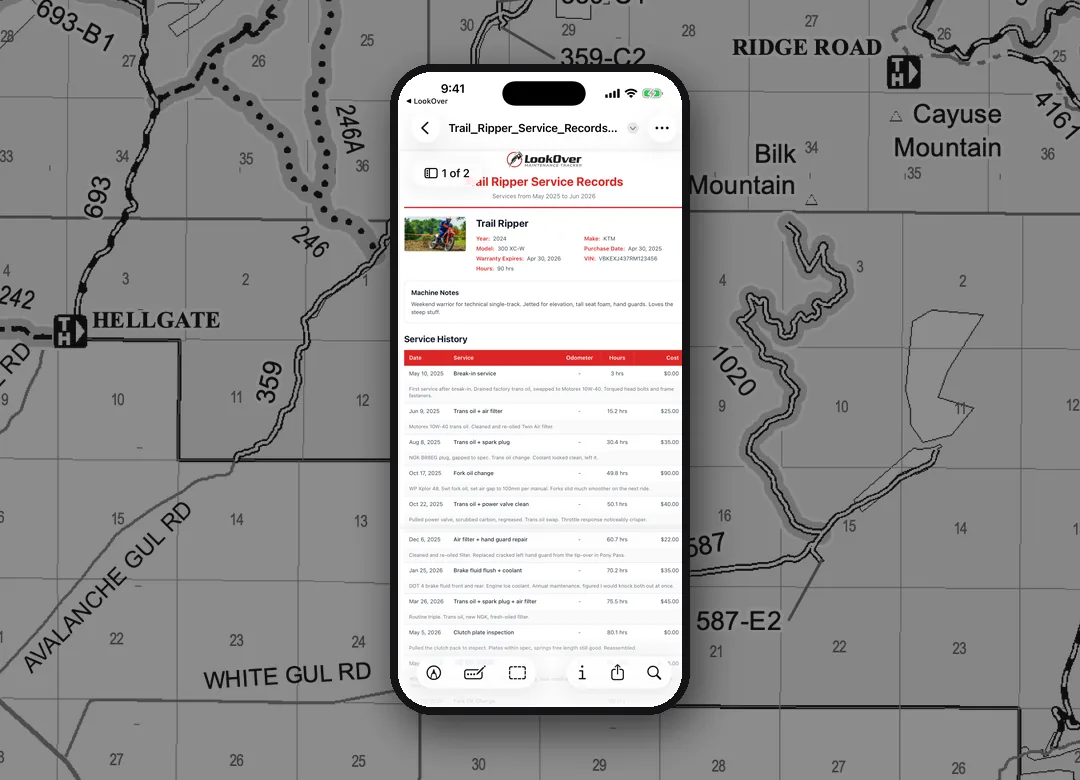
Export Service Records. One tap, and the PDF does the convincing for you.
Then the lowball question shows up, because it always does. Now you are holding a document that explains why the price is the price. "Top end at 42 hours, suspension serviced in March, here is the sheet" is a much stronger position than "haha what is the highest you would pay." You are not arguing. You are pointing at the record.
function(){throw Error("Attempted to call INTERACTIVE_MARKER() from the server but INTERACTIVE_MARKER is on the client. It's not possible to invoke a client function from the server, it can only be rendered as a Component or passed to props of a Client Component.")}At the actual sale, go one step further. LookOver can generate a QR code that hands the entire service history to the new owner. They scan it, and every oil change, every top end, every part you ever logged follows the machine instead of dying in your phone. Here is how the transfer works.
Starting from zero? Here is the weekend plan
If you are reading this with a bike already listed and nothing written down, you cannot invent a history. But you can reconstruct more of it than you think, and every dated entry helps.
- Pull your order history. Rocky Mountain, the dealer's parts counter, Amazon. Every parts order is a dated receipt for a job you did. Snap a photo of a receipt or drop in a shop invoice and LookOver pulls out the work, the parts, and the cost into a service entry.
- Scroll your camera roll. Most of us take a picture mid-job without thinking about it. The photo carries the date. Attach it to the entry.
- Paste your notes-app scroll. If you kept a running note, drop the whole thing into the Notes Importer. It comes out the other side as proper dated service records.
- Log only what you are sure of. Do not pad it. A short honest record beats a long fuzzy one, and buyers can tell the difference.
Then, from today forward, log every job the day you do it. By the time you sell the next machine, the answer to the records question is already sitting in your pocket.
Start before the listing goes up
The question in that screenshot is not rare. It is the opening line on nearly every used dirt bike listing in the country, and it lands whether you are ready for it or not.
The only way to answer yes is to have started earlier. Thirty seconds after each job, every job, and the records build themselves. Come sale day you hand over a PDF instead of a shrug, and you hold your price.
If you want the numbers behind why records move the price, read the full resale value breakdown. If you just want to stop being the guy with no records, start free with LookOver and log the next job.