
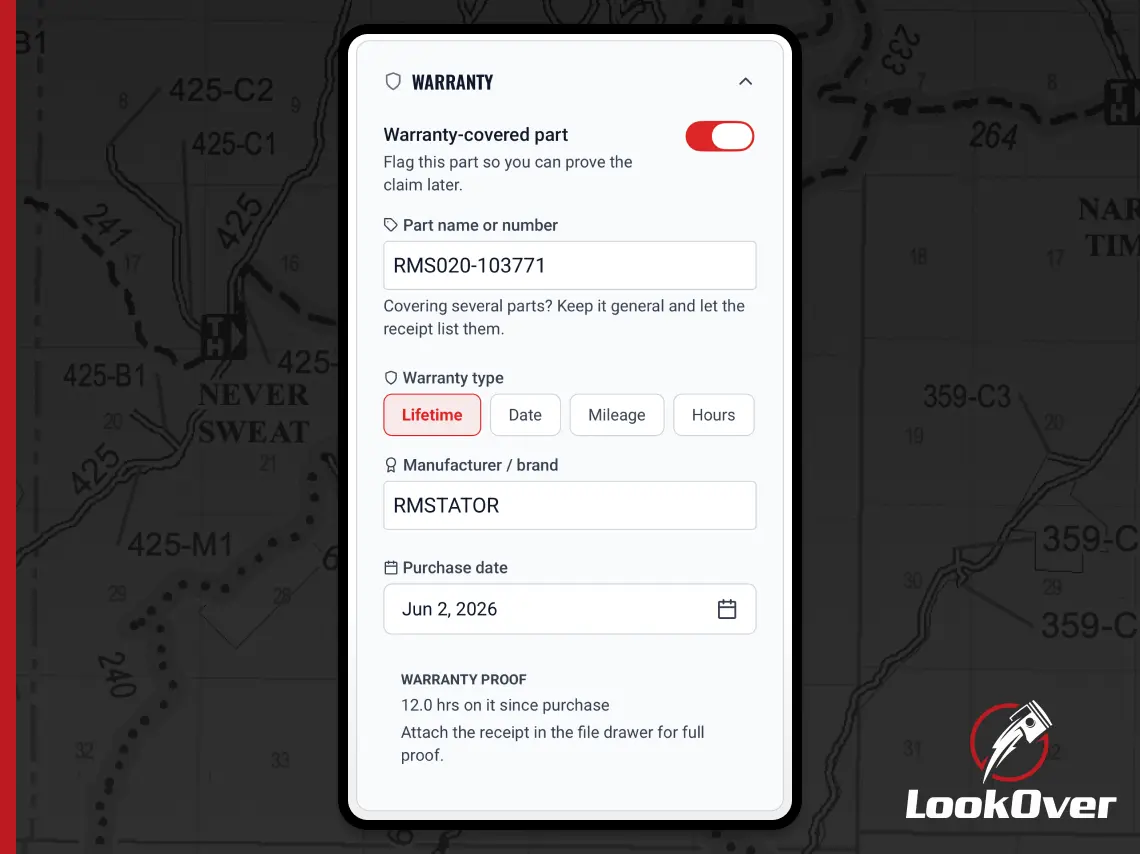
Your brake pads came with a limited lifetime warranty. You know that because the guy behind the counter said so, and it sounded great at the time. That was eighteen months ago.
Now they're shot. So where's the receipt?
That's the whole problem with warranties. The coverage is real. It's the proof that goes missing.
A warranty you can't prove isn't a warranty
Nobody is holding your paperwork for you. Some shops can pull up an old ticket. Plenty can't, not two years later, and not off a cash sale at the parts counter. When it's time to make a claim, four things land on you: what the part was, when you bought it, who honors the coverage, and something in writing that backs it up.
Miss any one of them and you buy the part again at full price. A part that was already covered.
Lifetime coverage is the worst offender, and it's backwards from what you'd expect. The longer the coverage runs, the less likely you are to remember it exists. Coverage that outlives your memory of it isn't worth much.
Two layers, and most riders only track one
The machine itself. Most people have a rough idea when the factory warranty on a new sled or side by side runs out. Put the purchase date and the expiration into LookOver and you stop guessing. Manufacturer coverage and an extended plan each get their own date, and the app starts tapping you on the shoulder around 90 days out, then again as the deadline gets closer. That's the window where a nagging noise is worth a dealer visit instead of a shrug. It's free on every plan, because a heads-up shouldn't cost anything.
The parts you bolt on after that. This is the layer almost nobody tracks, and it's where the money hides. Pads, rotors, batteries, shocks, wheel bearings, a top end done at a shop. Every one of those can carry its own coverage, on its own clock, long after the machine's factory warranty is dead and gone.
One receipt, more than one clock
Here's the case that shaped how this works. A brake job at O'Reilly: two rotors carrying a two year limited warranty, and a set of ceramic pads carrying a limited lifetime warranty. One receipt, one visit, two completely different terms. If a service could only hold a single warranty, the rotors would quietly disappear.
So a service holds a list of covered parts instead of just one. Each part gets its own name, brand, purchase date, and coverage shape:
- Lifetime. No clock at all.
- A date. Two years, 90 days, whatever the term happens to be.
- Miles. Coverage that runs out at a distance.
- Hours. The one that car-focused apps never get right, and the one that matters most on a machine with no odometer.
Then attach the actual receipt to that service. A photo of the paper slip, the emailed PDF, whatever you've got. The proof ends up in the same place as the work instead of scattered across a drawer, a glovebox, and your memory.
One thing worth knowing: a shop's blanket "all work guaranteed 90 days" is a labor guarantee, not a part warranty. Different thing, different claim.
Finding it later, which is the entire point
Recording any of this only helps if it surfaces at the right moment, and the right moment is always the same one. Something fails, and you're standing there wondering whether you're about to pay for it.
Services you flag get a warranty tag right on the card in your log, so covered work is visible at a glance. Your service list also has a filter for warranty parts. One tap and you're looking at every covered part you own, with the dates and the receipts already attached. No shoebox. No scrolling back through two years of email.
Covered, or not covered, in about five seconds.
Let the receipt fill itself in
Typing part names off a receipt is exactly the kind of chore that makes people skip the whole thing, so LookOver Pro can read the receipt for you. Point your camera at a parts invoice and it pulls out the line items, the cost, the shop, and the warranty printed against each part. That rotor and pad receipt comes back as two separate covered parts, already filled in, ready to save.
It only records coverage the document actually states. It won't decide something is covered based on the brand or the price, which is the right call. A warranty record you can't trust is worse than no record at all.
Worth the two minutes
A set of pads is 60 bucks. A battery is 150. A shock rebuild is more. None of it is going to bankrupt you, and that's exactly why it slips. It's never quite annoying enough to fix, just annoying enough to sting every time.
Two minutes when you log the service. Years of being able to prove it.
Next time you're in the app, run back through your recent services and flag the parts you know are covered. Then keep doing it as you log. That's the whole habit.
You already paid for that coverage when you bought the part. You may as well be able to use it.