The Complete Utility & Work UTV Maintenance Guide
Dec 19, 2025

Hour-by-hour care for machines that earn their keep
Your utility UTV isn't a toy. It's a tool.
It hauls feed across the back forty. Pulls trailers loaded with firewood. Carries tools and supplies to fix fence lines a mile from the barn. Checks cattle in weather that would strand a pickup truck.
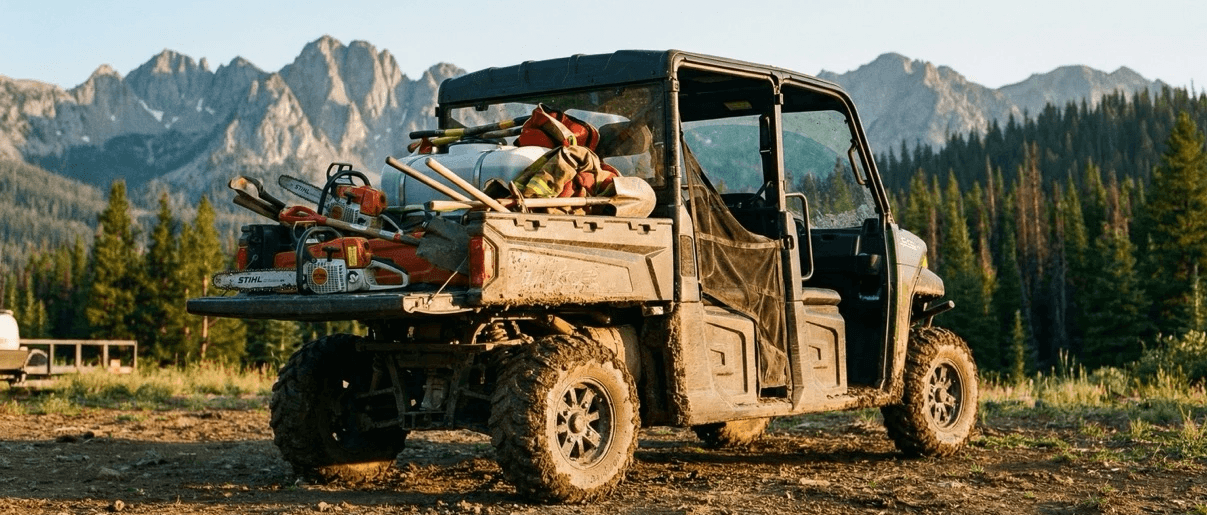
Ranger loaded with gear heading to the job site. Rhino with a spray rig in the bed treating pastures. Every day, your machine does work that would take hours on foot or cost thousands to hire out.
These machines are built to work. Built to haul. Built to handle loads that would break lesser equipment.
But "work-grade tough" doesn't mean "maintenance-free." Your utility UTV operates in conditions most vehicles never see. Mud. Dust. Heavy loads. Slow-speed grind. Hours of idling while you work.
This guide covers the workhorses: Polaris Ranger XP 1000 (modern work machine), Polaris Ranger 700 (proven early-era reliability), and Yamaha Rhino 660/700 (the machine that defined the category).
Whether you're running a ranch, managing land, or hunting backcountry, this guide keeps your UTV working when you need it.
Let's get to it.
What's Inside
Every Day: Pre-Work Inspection
Break-In Period: Critical First 25 Hours
Every 50 Hours: Regular Service
Every 100 Hours: Major Service
Every 200+ Hours: Deep Maintenance
Towing and Hauling: What Your Machine Can Handle
Seasonal Prep: Winter and Hunting Season
Older UTVs: Maintaining Early-Era Machines
Your Complete Maintenance Schedule
Every Day: Pre-Work Inspection
Three minutes before you load up saves hours stranded in the field.
Utility UTVs break when you skip the basics. Every time.
The Walk-Around
Tires and cargo:
Tire pressure: 10-20 PSI (adjust for load, check manual)
Tire damage: Cuts, punctures, uneven wear from heavy loads
Cargo bed: No cracks in bed, tailgate latches work
Cargo weight: Never exceed rated capacity (typically 1,000-1,500 lbs)
Overloaded cargo bed changes handling and can damage frame mounts. Know your limits.
Fluid levels:
Engine oil: Dipstick with machine level on flat ground
Coolant: Reservoir when cold (many utility UTVs are liquid-cooled)
Brake fluid: Master cylinder, above minimum line
Transmission/gearcase oil: Check sight glass or fill plug
Leaks check:
Look under machine for fresh oil, coolant, or hydraulic fluid
Check around transmission and front differential
Inspect hydraulic dump bed cylinders (if equipped)
Hitch and towing:
Hitch pin secure with safety clip
Trailer lights working (if towing)
Safety chains attached
Tongue weight within spec
Safety equipment:
Seat belts functional
ROPS (roll cage) secure with no cracks or bends
Side nets or doors latched properly
The Function Check
Start engine, verify:
Oil pressure builds quickly
No warning lights stay on
Smooth idle
Parking brake holds
Test basic operation:
Brakes: Firm pedal, consistent stopping
4WD/differential lock: Engages smoothly (if equipped)
Shifter: All ranges work (H, L, N, R, P)
Dump bed: Hydraulics operate smoothly (if equipped)
Quick test drive:
Verify no new sounds or vibrations
Test brakes under light load
Confirm steering feels normal
If something's different, figure it out before you're two miles from the barn with 800 pounds of feed in the bed.
Break-In Period: Critical First 25 Hours
New machines need careful initial use. This sets the foundation for the next 2,000+ hours.
Polaris Ranger: First 25 Hours or 500 Miles
Operating restrictions:
First 3 hours: No full throttle, no high speeds
Avoid sustained high RPM
Vary engine speed (don't cruise at constant throttle)
Operate in Low gear for heavy loads during break-in
Pull only light loads initially
Avoid aggressive acceleration
Why this matters for work machines:
Low-speed hauling is less critical than aggressive acceleration. The engine can handle work, just keep speeds moderate and vary the load.
25-hour break-in service:
Engine oil and filter change (mandatory)
Transmission fluid level check
Front gearcase fluid level check
Brake system inspection
Drive belt inspection (if CVT)
General lubrication of all fittings
Yamaha Rhino: First 200 Miles or 1 Month
Operating restrictions:
Initial 320 km (200 miles): Vary speeds, avoid constant RPM
Valve clearance check at 200 miles (critical for older single-cylinder engines)
Monitor oil level frequently
200-mile service:
Valve clearance inspection and adjustment
Engine oil change
Final gear oil inspection
Complete lubrication
Brake system check
Older machine, simpler break-in. These were built when UTVs were simpler. Follow the manual exactly.
Break-In Reality for Work Machines
You bought this to work, not to baby.
Good news: Moderate-speed work during break-in is fine. Hauling at 15 mph is less stressful than aggressive trail riding.
You CAN:
Haul moderate loads
Work at low speeds
Use Low range for heavy pulling
You CANNOT:
Run at sustained high speeds
Pull maximum loads
Skip the break-in service
Do break-in correctly, and your UTV will still be working 15 years from now.
Every 50 Hours: Regular Service
For work machines, 50 hours comes quickly. That's two weeks of full-time use.
Oil Level Check (Every Day if Possible)
Takes 30 seconds. Prevents $3,000 engine rebuilds.
Low oil from a leak or consumption can destroy an engine in hours, not days.
Air Filter Service
Inspection frequency:
Dusty ranch work: Every 20-30 hours
Normal conditions: Every 50 hours
Muddy/wet conditions: After every heavy use
Service procedure:
Remove filter
Inspect for damage or excessive dirt
Clean with compressed air (from inside out) or replace
Check housing for dirt intrusion
Verify seal seats properly
Clogged air filter symptoms:
Loss of power
Increased fuel consumption
Black smoke from exhaust
Hard starting
Work machines operate in dust constantly. Service air filters religiously.
General Lubrication
Grease every 50 hours minimum:
All suspension pivots
Steering components
Driveshaft universals (shaft-drive machines)
Cargo bed pivot points
Any zerk fittings
Utility UTVs carry heavy loads at low speeds. This creates sustained stress on bearings. Grease prevents premature wear.
Brake Inspection
Check every 50 hours:
Pad thickness
Fluid level
No unusual sounds during braking
Parking brake holds securely
Hauling heavy loads downhill works brakes hard. Keep them fresh.
Quick Checks
Coolant level (liquid-cooled machines)
Battery terminals clean and tight
Drive belt condition (if CVT)
Tire condition and pressure
All lights function
Every 100 Hours: Major Service
This is comprehensive service. Budget 3-4 hours if DIY.
Engine Oil and Filter
Polaris Ranger XP 1000:
PS-4 5W-50 4-Cycle Oil (Polaris specification)
Change every 100 hours or 1,000 miles or yearly
Replace filter with every oil change
Never mix brands or use non-recommended oil
Yamaha Rhino 660/700:
API SE, SF, or SG type or higher
SAE 10W-30, 10W-40, 20W-40, or 5W-30 depending on temperature
Change every 2,400 miles (1,500 km) or 6 months
Replace filter every 4,800 miles or 12 months
Capacity: 2.2L with filter (Rhino 660)
Oil analysis tip:
When draining, inspect old oil for:
Metal particles (bearing or ring wear)
Milky appearance (coolant contamination)
Burnt smell (overheating)
Old work machines tell you problems through oil condition.
Transmission and Gearcase Service
Polaris Ranger (CVT):
Change transmission fluid: 41 fl oz AGL formula
Change front gearcase fluid: 9.3 fl oz Demand Drive fluid
Maintain proper levels (critical for drivetrain life)
Yamaha Rhino (CVT with shaft drive):
Final gear oil: SAE 80 API GL-4 Hypoid, 0.28L capacity
Differential gear oil: SAE 80 API GL-4 Hypoid, 0.33L capacity
Change every 4,800 miles or 12 months
Shaft drive = less maintenance than chain, but fluid critical
CVT System Service
Belt inspection:
Remove CVT cover
Measure belt width (compare to specification)
Check for cracks, fraying, glazing
Look for chunks missing or uneven wear
Belt life in work use:
Light hauling, normal conditions: 300-500 hours
Heavy loads, frequent towing: 200-300 hours
Severe duty (mud, hills, heavy loads): 100-200 hours
Clutch cleaning:
Remove belt dust buildup
Inspect rollers and bushings
Check for wear on sheaves
Clean with approved cleaner (no petroleum solvents)
Keep CVT clean. Dust accumulation causes overheating and premature wear.
Spark Plug Service
Inspection: Every 100 hours
Replacement: Every 200-300 hours or as needed
Polaris Ranger:
Gap: 0.03 in (0.85 mm)
Torque: 9 ft-lb (12 Nm)
Yamaha Rhino:
Type: DPR8EA-9 (NGK)
Gap: 0.8-0.9 mm
Torque: 13 ft-lb (18 Nm)
Good plug = light tan color, no fouling, proper gap.
Cooling System (Liquid-Cooled Machines)
Inspection:
Coolant level and condition
Hose integrity (cracks, soft spots, leaks)
Radiator fins (bent or clogged)
Fan operation
Radiator cleaning:
Remove debris with low-pressure water
Clean from engine side outward
Don't bend cooling fins
Work machines get dirty. Radiators get clogged. Clean them.
Fuel System
Inspect fuel lines for cracks or damage
Check fuel filter condition (if accessible)
Verify fuel cap vent not clogged
Ensure fuel level sender works
Drive Components (Shaft Drive Machines)
Yamaha Rhino and similar:
Inspect CV joint boots for tears or cracks
Check driveshaft U-joints for play
Verify differential mounts secure
Listen for unusual noises in 4WD
Shaft drive is reliable but needs fluid changes and boot inspection.
Battery Service
Check voltage (should be 12.6V+ when fully charged)
Clean terminals if corroded
Verify charging system works (13.5-14.5V running)
Load test if starting issues
Work machines sit idle during winter. Maintain battery health.
Every 200+ Hours: Deep Maintenance
Valve Clearance
Polaris Ranger XP 1000:
Check every 310 hours or 3,100 miles
Professional service (requires special tools)
Yamaha Rhino:
Check every 2,400 miles or 6 months
Initial check at 200 miles critical
Can adjust with basic tools (shim-under-bucket)
Single-cylinder engines (Rhino) require more frequent valve service than twins (Ranger).
Brake Fluid Replacement
Every 2 years minimum regardless of hours.
Work machines sit more than play machines. Brake fluid absorbs moisture while sitting. Old fluid = brake fade and corrosion.
Service procedure:
Flush entire system
Use DOT 4 fluid
Bleed all calipers thoroughly
Verify firm pedal feel
Shock Absorber Service
Inspection: Every 100 hours
Rebuild/replace: When symptoms appear or every 500+ hours
Symptoms:
Oil leaking from seals
Harsh ride
Bottoming out under normal loads
Uneven handling
Work machines don't jump, but heavy loads stress shocks. Service when needed.
Suspension Component Inspection
Check every 200 hours:
Tie-rod ends for wear or play
Ball joints for looseness
Wheel bearings for excessive play
Bushings for deterioration
Heavy loads accelerate wear on these components. Catch them early.
Drive Belt Replacement
Even if belt looks okay, replace at 300-400 hours for work use. Don't wait for failure.
Carry spare belt always. Remote ranch work with no spare is asking for a long walk back.
Towing and Hauling: What Your Machine Can Handle
This is why you bought a utility UTV. Know the limits.
Cargo Bed Capacity
Polaris Ranger XP 1000:
US models: 1,000 lbs
CA models: 600 lbs (regulatory difference)
Yamaha Rhino 660:
Maximum load: 397 kg (876 lbs) including operator, passenger, and cargo
Never exceed rated capacity.
Overloading changes handling, stresses frame mounts, and can damage bed or ROPS attachment points.
Towing Capacity
Varies by machine and configuration. Check your specific manual.
General towing guidance:
Use manufacturer-approved hitch only
Attach safety chains
Never exceed tongue weight limit (typically 10% of trailer weight)
Use Low range for heavy loads
Verify trailer brakes if required
Load Distribution
Cargo bed loading:
Heavy items low and forward
Secure all loads (no loose items)
Don't exceed bed side height (affects stability)
Tongue weight:
Too little: Trailer sways
Too much: Lifts front end, affects steering
Just right: 10-15% of total trailer weight
Operating Under Load
Best practices:
Use Low range for towing and hauling
Reduce speed (especially downhill)
Increase following distance
Brake earlier and gentler
Watch coolant temperature on hills
CVT systems work harder under load. Low range reduces heat buildup.
Seasonal Prep: Winter and Hunting Season
Work machines have two busy seasons: spring work and fall hunting. Prepare accordingly.
Spring Prep (Ranch Work Season)
Before first heavy use:
Complete oil change even if winter hours low
Grease all fittings thoroughly
Check tire pressure (adjust for loads)
Inspect cargo bed and tailgate operation
Verify hitch and towing equipment
Test hydraulic dump bed (if equipped)
After winter storage:
Fresh fuel (winter fuel may have degraded)
Battery charge and test
Check coolant antifreeze protection
Inspect belts and hoses
Test all lights
Fall Prep (Hunting Season)
Before season:
Oil change if near interval
Check brakes (hauling game downhill works them hard)
Inspect tires (rough terrain ahead)
Verify cargo tie-downs secure
Clean cargo bed thoroughly
Test winch if equipped
During season:
Check cargo bed for game blood (clean regularly, prevents corrosion)
Monitor tire pressure with heavy loads
Wash underside after muddy retrieval
Keep spare belt accessible
Winter Storage (If Seasonal Use)
If storing 3+ months:
Change oil (don't store dirty oil)
Fill fuel tank, add stabilizer
Run engine to circulate treated fuel
Remove battery, store indoors on tender
Inflate tires to max pressure
Cover machine with breathable cover
Grease all fittings (protects during storage)
Spring startup:
Charge and install battery
Check all fluid levels
Inflate tires to proper pressure
Inspect for rodent damage
Start and let warm completely before use
Older UTVs: Maintaining Early-Era Machines
Polaris Ranger 700 (2005-2009) and Yamaha Rhino 660/700 (2004-2013) are proven workhorses. Many are still earning their keep 15-20 years later.
What Makes Older UTVs Different
Simpler systems:
Often air-cooled or simpler liquid cooling
Carbureted engines (no fuel injection)
Manual transmission options (some models)
Fewer electronics
Mechanical gauges
Easier to fix:
Parts still available (mostly)
Less complex diagnostics
Can repair with basic tools
Cheaper maintenance overall
More frequent service:
Older designs require closer attention
Adjust valves more often
Clean carburetors seasonally
Monitor simple electrical systems
Yamaha Rhino Specific Maintenance
Carburetor service:
Clean every 2,400 miles or 6 months
More often if sitting long periods
Drain fuel when storing
Valve clearance:
Critical service on single-cylinder engines
Check every 2,400 miles
Adjust with shims (not difficult, just careful)
Electrical system:
Simple 12V system
Easy to troubleshoot
Battery maintenance critical
Shaft drive:
Very reliable
Just change gear oil regularly
Inspect CV boots for tears
Keeping Older Machines Running
Preventive maintenance matters more:
Newer machines tolerate missed services better
Older machines punish neglect quickly
But they're simpler to fix when problems happen
Parts availability:
Genuine OEM often still available
Aftermarket expanding for popular models
Keep common wear items in stock
When to retire:
Frame damage or ROPS cracks (safety issue)
Major engine failure with high hours (rebuild costs don't justify)
Transmission failure on high-mileage machine
Otherwise, keep them running. Many Rhinos and early Rangers have 3,000+ hours and still work daily.
Your Complete Maintenance Schedule
Every Day of Use
Tire pressure and condition
Oil level check
Coolant level (liquid-cooled)
Brake fluid level
Visual leak check
Cargo bed inspection
Safety equipment check
Break-In (One-Time)
Polaris Ranger: 25 hours or 500 miles
Engine oil and filter
Transmission fluid check
Front gearcase check
Brake system inspection
Complete lubrication
Yamaha Rhino: 200 miles or 1 month
Valve clearance check and adjustment
Engine oil change
Final gear oil inspection
Brake system check
Every 50 Hours
Air filter service
General lubrication (all fittings)
Brake inspection
Tire condition check
Drive belt inspection (if accessible)
Battery check
Every 100 Hours (or Yearly)
Engine oil and filter change
Transmission fluid change
Front gearcase fluid change
Spark plug inspection
Cooling system inspection
Fuel system inspection
Brake system inspection
CVT system service (belt and clutches)
Complete drivetrain inspection
Every 200 Hours (or As Needed)
Valve clearance check
Brake fluid replacement (or 2 years)
Shock absorber service
Suspension component inspection
Drive belt replacement (preventive)
Every 6 Months (Low-Hour Machines)
Oil change (even if hours low)
Lubrication service
Brake fluid check
Battery charge and test
Complete inspection
Annual (Minimum Service)
Oil and filter change
Air filter service
Grease all fittings
Brake system inspection
Tire inspection
Safety equipment check
All lights function test
Common Work Machine Problems
Problem: Belt Slipping Under Load
Symptoms:
Loss of power when hauling or towing
Burning smell from CVT
High RPM but low ground speed
Causes:
Worn belt (most common)
Glazed clutch faces
Overloading machine
Operating in wrong gear range
Solution:
Replace belt
Clean clutch faces
Use Low range for heavy loads
Don't exceed rated capacity
Problem: Overheating on Hills
Symptoms:
Coolant temperature gauge high
Loss of power
Steam from radiator overflow
Causes:
Clogged radiator (mud, debris)
Low coolant level
Failed thermostat
CVT overheating (different issue)
Solution:
Clean radiator thoroughly
Check coolant level and condition
Replace thermostat if stuck
Use Low range on hills (reduces CVT heat)
Problem: Poor Braking Performance
Symptoms:
Soft pedal feel
Increased stopping distance
Pulling to one side
Causes:
Worn brake pads (most common with heavy loads)
Air in hydraulic system
Contaminated brake fluid
Warped rotor from overheating
Solution:
Replace pads if worn
Bleed brake system
Replace brake fluid
Inspect rotors for warping
Problem: Hard Starting or No Start
Symptoms:
Engine cranks but won't fire
Weak cranking
No crank at all
Causes:
Dead battery (most common)
Carburetor issues (older machines)
Fuel pump failure
Safety switch issues
Solution:
Charge or replace battery
Clean carburetor (carbureted machines)
Check fuel pump operation
Verify parking brake, neutral switch function
Problem: Transmission Slipping or Not Engaging
Symptoms:
CVT belt squealing
No power transfer to wheels
Delayed engagement
Causes:
Worn or broken belt
Damaged clutch components
Low transmission fluid
Failed drive components
Solution:
Inspect and replace belt
Service CVT system completely
Check fluid levels
Professional diagnosis if internal damage
Critical Spare Parts and Tools
Minimum to Carry on Remote Properties
Spare drive belt (CVT machines)
Basic tool kit (wrenches, sockets, screwdrivers)
Tire plug kit and pump or CO2
Zip ties and duct tape
Tow strap
Work gloves
Flashlight
For Serious Ranch/Hunting Use
Extra engine oil and filter
Spare spark plug
Fuses (various sizes)
Hose clamps and short lengths of hose
JB Weld or similar emergency sealant
Jumper cables or jump starter
Fire extinguisher
First aid kit
Shop Supplies for DIY Maintenance
Oil drain pan and funnel
Grease gun with proper grease
Torque wrench
Oil filter wrench
Air pressure gauge
Basic metric socket set
CVT clutch tools (if servicing yourself)
Quick Reference: Common Specs by Machine
Always verify in your specific manual
Polaris Ranger XP 1000 (2023)
Item | Spec |
|---|---|
Engine | 999cc twin, liquid-cooled |
Oil | PS-4 5W-50, Polaris specification |
Oil change | 100 hours or 1,000 miles or yearly |
Transmission | AGL fluid, 41 fl oz |
Front gearcase | Demand Drive fluid, 9.3 fl oz |
Tire pressure | 10-20 PSI (varies by model) |
Cargo capacity | 1,000 lbs (US) / 600 lbs (CA) |
Transmission type | CVT |
Polaris Ranger 700 (2005-2009)
Item | Spec |
|---|---|
Engine | 700cc twin |
Oil change | Every 100 hours or 6 months |
Transmission type | CVT |
Drive type | Shaft drive |
Service intervals | Follow 2005-2009 manual specifics |
Yamaha Rhino 660 (2004-2007)
Item | Spec |
|---|---|
Engine | 660cc single, liquid-cooled |
Oil | API SE/SF/SG, SAE 10W-30 to 20W-40 |
Oil capacity | 2.2L with filter |
Oil change | 2,400 miles or 6 months |
Valve check | Every 2,400 miles (critical) |
Final gear oil | SAE 80 GL-4, 0.28L |
Differential oil | SAE 80 GL-4, 0.33L |
Spark plug | DPR8EA-9 (NGK), gap 0.8-0.9mm |
Max load | 876 lbs total including operator |
Transmission type | CVT with shaft drive |
The Reality of Utility UTV Ownership
You didn't buy a $15,000-25,000 machine to let it sit in the barn.
You bought it to work. To haul. To get to places trucks can't go and do jobs that would take all day on foot.
Ranch work. Hunting. Land management. Daily chores.
Your UTV pays for itself in saved time and capability. But only if it starts when you need it.
Miss an oil change? Engine seizes 10 miles from the barn with a load of fence posts.
Ignore air filter? Dust destroys the engine in one season of field work.
Skip brake service? Hauling a game animal downhill with failed brakes is a good way to hit a tree.
Neglect belt maintenance? Stranded in the back forty waiting for a tow truck that charges by the mile.
Utility UTVs are reliable when maintained. Neglected, they're expensive projects that sit broken when you need them most.
The good news: Maintenance isn't complicated. It's consistent.
Fresh oil. Clean air filter. Good belt. Proper fluids. Working brakes.
That's 90% of it. Do those things on schedule, and your UTV will still be working when the odometer hits 3,000 hours.
Track Every Hour. Know Every Service. Work With Confidence.
Oil change at 92 hours or 112 hours? Belt replaced last fall or two falls ago? Valve clearance checked or overdue?
You work every day. You don't have time to track exact service intervals.
LookOver handles it. Set your UTV's service intervals once. Get reminders before you're due. Know exactly when oil was changed, when belt was replaced, when brakes were serviced.
One app. Every hour tracked. Every service logged.
Download for iOS | Download for Android
Free to start. No credit card required.
Maintain It Right. Get the Work Done.
The best work days are the ones where your equipment just works.
Fresh oil means the engine starts every morning. Clean air filter means full power pulling loads. Good belt means no hesitation when you need to haul.
Utility UTVs are built to work. Maintain them accordingly.
Follow the schedule. Use the right parts. Fix problems before they strand you.
Then get back to work. 🚜
Disclaimer: This guide provides general maintenance recommendations for utility and work UTVs based on manufacturer service manuals from Polaris and Yamaha. Always consult your specific owner's manual for manufacturer-recommended intervals and procedures. Service intervals may vary based on use conditions, loads, and individual machine specifications. Older machines may require more frequent service than newer models.